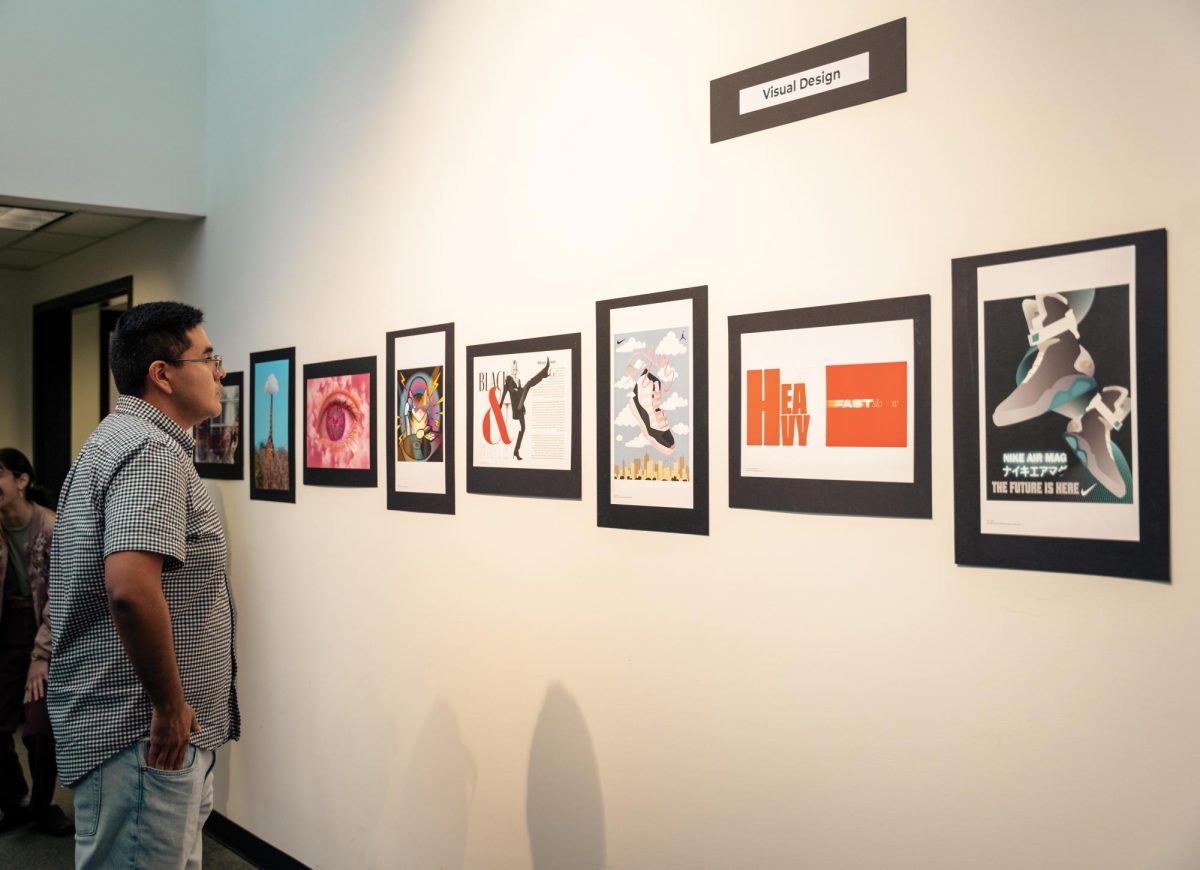
Dallas College Brookhaven held a Digital Art & Design Showcase on April 20, focusing on celebrating student works and community during a formal ceremony. The two hour event was presented as a social gathering at the Atrium Exhibit Hall, letting student creators share their work in a low pressure environment. Instead of an award ceremony, the showcase focused on the diversity of the program, including everything from User Experience (UX) and User Interface (UI) designs to motion graphics and 3D modeling.
The UX/UI portion of the showcase brought to light the program’s connections. Professor Sandy Harris mentioned that students have the opportunity to form connections with the Board of Trustees, as well as seek out internship opportunities that have been integrated into the program itself. Harris said the classes can be challenging, but gives students an idea of real industry standards and expectations, providing students a better chance at thriving in real world teams where they can apply their skills.
The animation displays helped set the tone of the celebratory atmosphere. Music videos and character animations looped on a screen near the door of the venue. A small crowd formed around it like a watch party, and stayed busy for the full two hours. In addition, a collection of animated images lined a wall nearby, showing that technical skill and artistic expression can go hand in hand. Rounding out the displays was another wall lined with visual and graphic designs, showcasing the unique expressions and experiences of each individual student artist. The mixed media brought light to the various directions students could take their work, and the shared viewing experience emphasised the strong creative community at Dallas College.
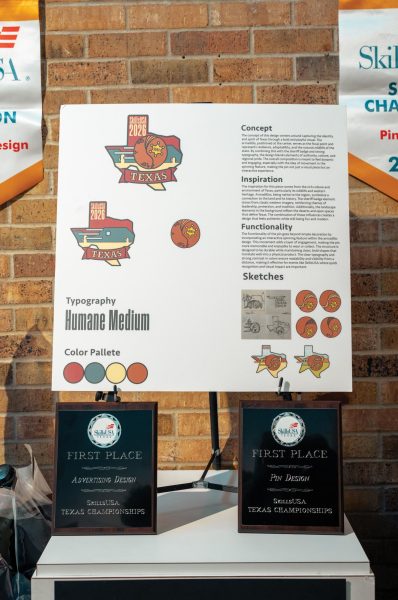
The showcase stayed intimate with only around 20 pieces on display inside a relatively small venue. With complimentary refreshments and snacks available near the entrance, the event seemed more like a celebratory mixer than a formal art gallery. The lower number of projects allowed the two hour window to be more effective, letting attendees really engage with each individual piece rather than needing to rush through a much larger collection. The smaller venue made sure that despite a lower number of pieces, the physical space was still crowded.